
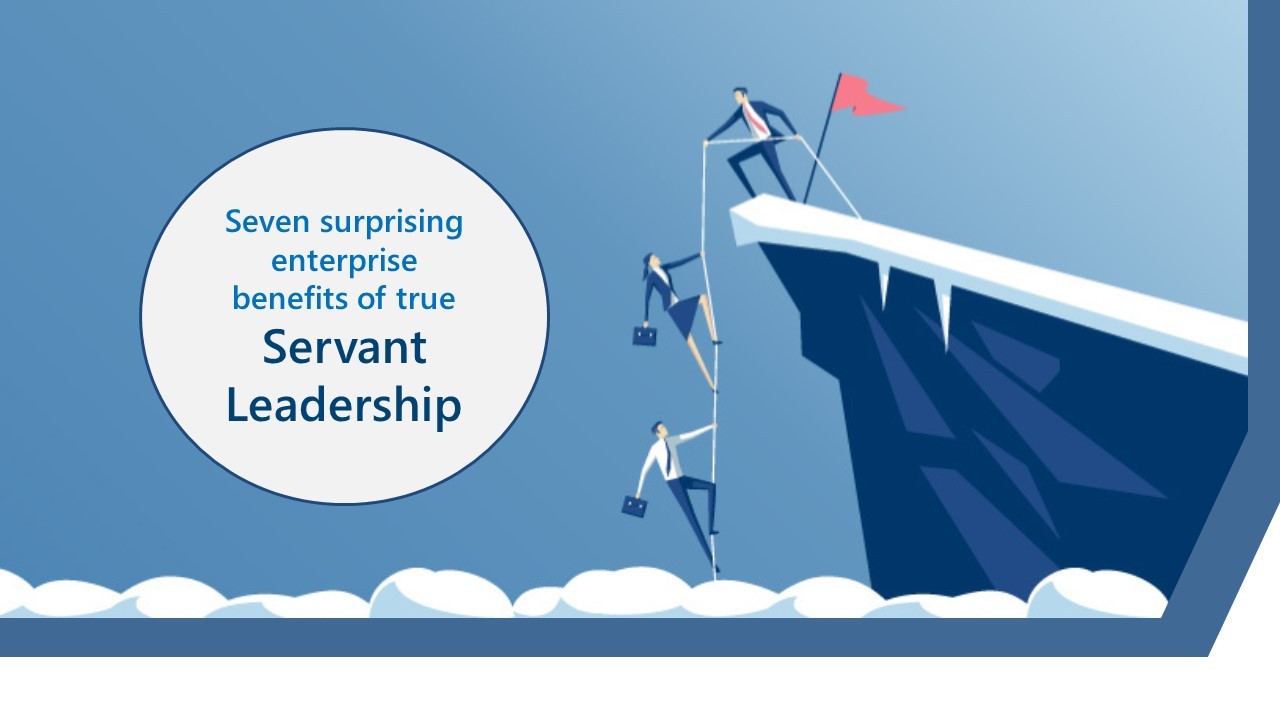
There is no shortage of buzzwords in our evolving lexicon. With misuse and overuse, many are drained of real meaning, leaving them to be used as punchlines more often than not. Servant Leadership is one of these peculiar terms that is used often but only practiced sparingly. You may be surprised to learn of some of the remarkable benefits that true Servant Leadership can bring to you and your organization.
While Servant Leadership is a character trait usually applied to the individual, I have found that the attitude behind this skill is contagious and can, over time, permeate an entire organization if treated with appropriate reverence. I’ve taken some time to compile some of the rich benefits I’ve seen associated with it for discussion.
1. Servant Leadership tends to energize the workforce.
There is a infectious component to sincere Servant Leadership that is rooted in our individualistic competitive spirit. No one wants to be outdone. Unconsciously, we eagerly accept the challenge to a higher level of behavior. The collective tends to rise in response to kindness, respect, and positivity; it’s visceral. While no guarantee, cultures adopt the attributes of their leaders, whether positive or negative, so setting the example using Servant Leadership brings the energy up a notch.
2. Servant Leadership helps get us into the Gemba.
In order to practice Servant Leadership effectively, we must interact directly with the workforce. There’s no better place to rub elbows with everyone than in the Gemba. Often management – particularly executive management – can become insulated from the place where the real value happens; the Gemba, in Lean parlance. Intentionally practicing Servant Leadership gets us out of our offices and into the thick of things, driving us to go and see for ourselves while we’re out. This is the classic “two birds with one stone” scenario.
Also, by cutting through the middle men, and getting a first-hand perspective of the situation we can cultivate higher levels of accountability and communication; particularly with the front lines. Think about how naturally delayed and filtered information can become without adequate interaction with our Gemba.
3. Servant Leadership helps humanize management and shows you care.
It is normal for an “us verses them” hierarchy to form in any organization. Unless we actively undermine it, this corrosive mindset will tend to take root and spread. Servant Leadership is a good means by which to strip away the distinctions that titles, parking spots, degrees, and corner offices can create. Not only does Servant Leadership indicate that you respect the individual you are serving, but it goes farther by implying that you actually care. One of the bedrocks of Lean thinking is “respect for people.” It acknowledges the role, the contribution, and the inherent value a person brings to the organization. People appreciate respect and typically reciprocate in kind. Be the first to get the respect ball rolling.
As an aside, there is a severe lack of sacrificial service in society today. There always seems to be something in it for the servant, so we naturally question the motivation. Therefore, don’t be alarmed if you meet up with some skepticism; you may very well be the only earnest servant they’ve ever come across before. Shoulder that burden responsibly.
4. Servant Leadership breaks down organizational barriers.
As we practice Servant Leadership we find that we appear more vulnerable, less threatening, less aloof. The usual impediments that interfere with access and communication begin to erode. Barriers that once stifled an organization can be broken down as we employ the habit of Servant Leadership. The open-handedness of Servant Leadership typically disarms environments that are normally known for their posturing and obstruction.
5. Servant Leadership forges personal bonds.
Organizational cultures are strengthened as the individual relationships within the organization grow and deepen. While we can’t be close to everyone, we can certainly connect. Research shows that people are having difficulty connecting in our increasingly detached and digital world. Discrete acts of Servant Leadership can serve to spark interpersonal relationships between you and your coworkers that will likely pay dividends in perpetuity.
6. Servant Leadership facilitates alignment.
This is one of my soapbox topics, so indulge me a moment. Alignment is an enormous problem in most companies. It’s a natural consequence of an unhealthy communication climate and of traditional corporate hierarchies. It epitomizes the “us verses them” construct that we hope to avoid. Misalignment is rooted in isolation; isolation from vision, from facts, from feedback, from access. We can all pull in the same direction when, and only when, we’re all on the same page. Because Servant Leadership breaks down walls and invites dialog, it can enhance alignment as a natural byproduct.
7. Servant Leadership enriches us as individuals.
Maybe you’re still unconvinced that there is sufficient value in personally adopting Servant Leadership. The truth is even if there were no other identifiable benefits from it, Servant Leadership is valuable because it serves to stretch us as individuals. The human condition is bogged down by our innate self-centeredness, complacency, and apathy toward our fellow man. Any activity that stimulates us to grow in areas such as compassion, selflessness, and humility will serve us well in this life. No one would resent you for having traits such as these. Think about it.
In my career I’ve come across some genuinely courageous servant leaders but unfortunately I’ve seen many more frauds that want to claim the mantle without walking the walk. It isn’t easy. It’s nearly always humbling. However, the benefits you and your organization can reap are well worth it. Do you want to be associated with the new class of businesses called “Firms of Endearment”? Do you want a highly motivated and engaged workforce? Do you want to experience the satisfaction of personal growth? Think about what Servant Leadership can offer you.
Lean In and Lean On.