
Often we can fall into the trap of believing that a process is “fixed” once we’ve applied our continuous improvement magic. Simply perform a kaizen or post some data trends, and now the problem is resolved. If Toyota taught us anything it is that the act of improvement can never stop, stall, or relent. If it does, things will slowly and steadily degrade back to their original sad state. Furthermore, if we don’t continue to perservere, our competition will eventually pass us by.
So how do we really “take it to the next level”? The Plan-Do-Check-Act cycle made famous by Deming gives us some interesting insight. As a pure cycle, PDCA requires iterative and successive application. So what are these successive cycles intended to produce, you may ask?
True, the expectation might be to sqeeze the process for ever better performance in Cost, Quality, or Delivery, but this is an overly simplistic goal. Deming intended for the cycle to also produce a more progressively sophisticated response. Understand that every process comes to be simply out of pure necessity. Processes are rarely planned at the onset. To the contrary. Processes are spun into motion and only refined some time later; when they are identified as a source or pain or poor performance. Mental energies are typically applied late in the game.
What if we took a more deliberate approach to the iterative PDCA cycle? What would it look like?
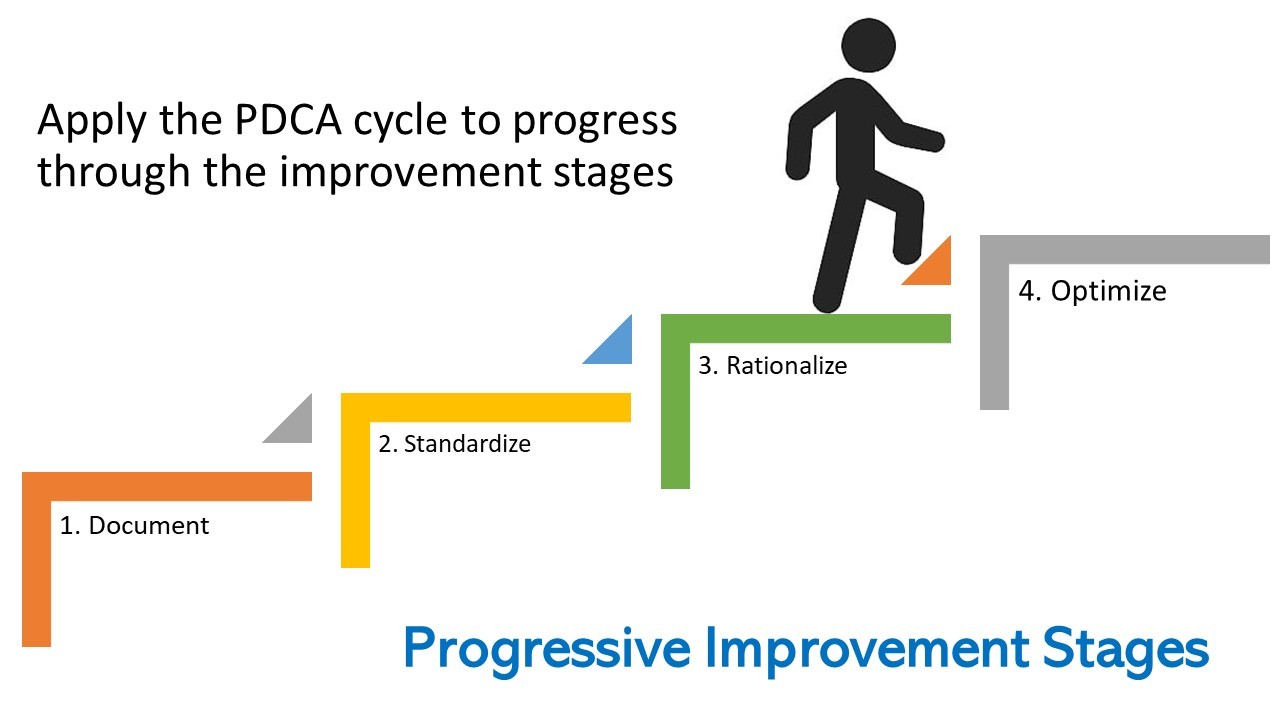
Initially, the first pass at any improvement attempt requires that it be painstakingly defined and that everyone agrees on the form and function of a given activity. Without this, everyone has only a vague notion of the intent, purpose, and mechanics of a specific process. Therefore, Documentation is the most primitive of these improvement stages. Documenting a process is the means by which we can all clearly and objectively assess something. Without it there is not a real means to even measure it. But we know we can do more.
The second logical state of improvement is Standardization. Once everyone has documented their steps in a process we can compare and contrast the various methods. However, we know there be only ONE BEST PRACTICE. Standardization is the stage where we assess all the options for a process and collectively embrace only the best practices for the benefit of everyone. More often than not in complex systems, we will find that the true best practice is a combination of existing practices rather than just one of the documentated processes.
The temptation is to stop here. Identifying and adopting a best practice is logical ending point for us. However, iterative improvement begs us to strive further. The third stage of improvement is Rationalization of the process or even a larger collection of processes. Obviously, processes can be classified as Value-Added or Non Value-Added ones. We don’t want to refine processes that add little or no value in the eyes of the ultimate customer. We also don’t want to cling to processes that, on the whole, aren’t adding the level of value that we demand as an organization. There could be products or services in our portfolio that simply don’t justify themselves. It’s time to take decisive action against activities that don’t pull their own weight. Alternative solutions might be sell-offs, out-sourcing services, divestment, or intense redesigns to justify keeping something. This is where management plays a key role in refining the entire business portfolio. Much like the Sort component of 5S, this is our opportunity to remove things from the business that truly don’t belong or are holding us back.
Next, we need to recognize that our new standardized process might be contaminated with waste of various kinds. The final stand-alone stage of improvement is Optimization. We optimize around specific performance factors. Optimization can’t be completed in a vacuum. It’s a strategic and intense effort that requires very specific objectives. You may elect to optimize around Cost, Quality, Delivery, Safety, or some other strategic lever, but this step MUST be deliberate. If you optimize around everything, you effectively optimize around nothing. You must answer the following question: “On what aspect is this process/product/service going to compete in the marketplace?” This facet must be clearly distinguishable to be effective. Choose with care.
Most initiatives never make through all four these stages of improvement. Many stall out at the very beginning. Armed with this perspective, how will you manage the next improvement project? Will “take it to the next level” or will you believe that “once and done” is good enough?
Lean In and Lean On.