
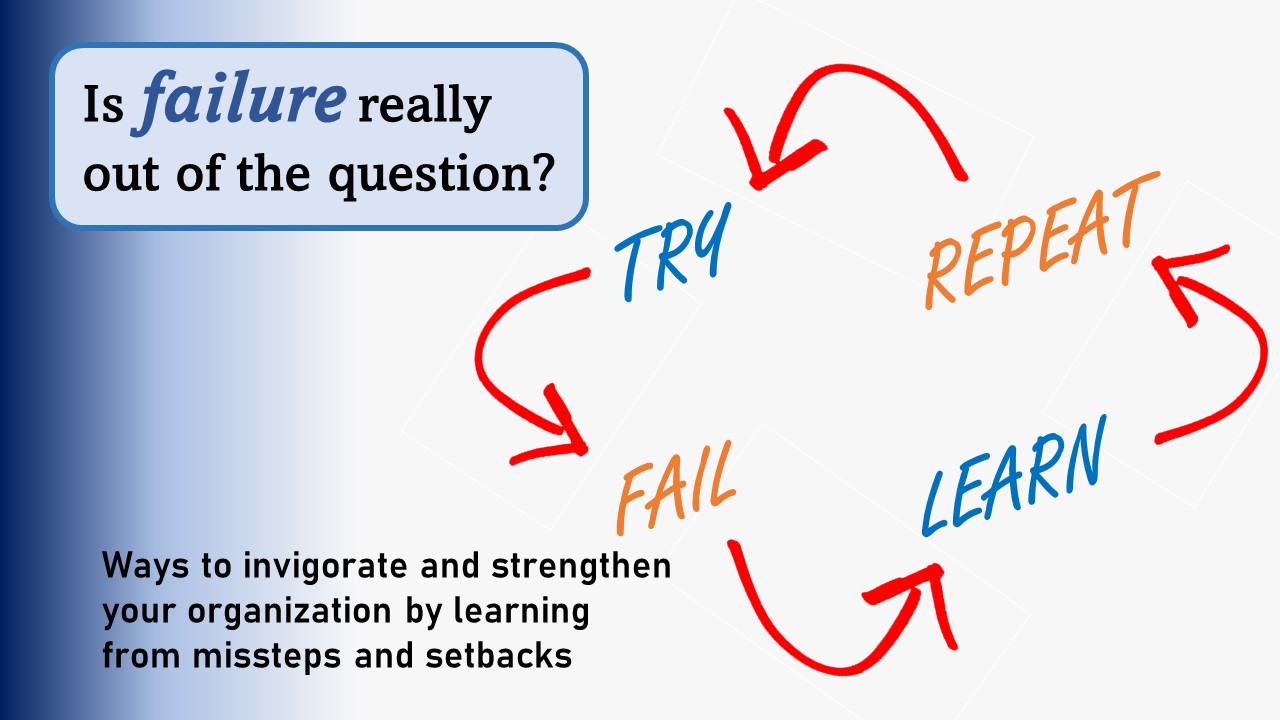
Much hay is made today that we need to “fail fast, learn, then move forward.” It strikes me as particularly dis-ingenuine however, because the mindsets prominent in most organizations are not fond – or even tolerant – of failure. One could argue that failure is a prerequisite for learning, for without failure we’ve only validated what we already knew to be true. Failure opens to door to new possibilities. Failure coupled with rigorous and honest reflection can generate substantial insight, growing our collective knowledge and understanding of the world around us.
Does anyone in your organization celebrate failure? Doubtful. I have yet to see any resume that flagrantly boasts of a past failure. Nonsense! Instead, failures are systematically omitted, even though they were probably associated with intense events that led to great accomplishments if sufficient reflective learning took place.
So why is there such an aversion to even the slightest hint of failure? And why do our organizations discourage risk to the degree that it is well understood that “failure is not an option here”?
The very heart of the scientific method beats upon routine failure. Step one, form a hypothesis based upon observation. Step two, devise an experiment to test this hypothesis. Step 3, draw a logical conclusion – based on the results of the experiment – that lends evidence to the validity of the hypothesis. When the experiment goes sideways and the results are surprising or run counter to our hypothesis, then the opportunity for deeper learning presents itself!

All organizations have cultures that are either risk tolerant or risk averse. Risk tolerant cultures reward unconventional thinking, intelligent experimentation, creative problem solving, and innovation. Risk averse cultures simply do not. They encourage and even demand that the team plays it safe. The unspoken motto of risk averse organizations is “we’ve always done it this way,” or even worse “keep your head down and just do your job.” More importantly, there is a pervasive self-consciousness that manifests itself as fear and blame in risk averse environments.
If you haven’t already read it, I highly recommend Katie Anderson’s book entitled “Learning to Lead, Leading to Learn.” It’s a fascinating memoir of sorts on the learning journey of a truly remarkable Japanese leader in the formative Toyota years. One of the lessons in the book that still gives me great pause concerns the subject’s first assignment as a fresh recruit. As a massively naïve new employee, he mistakenly mixes up two chemicals that cause the entire line to grind to a halt, causing massive rework and downtime. Please read the book for the details, but the result was that the manager expressed thanks for exposing the procedure’s vulnerability and apologized for the faulty process. I’ve heard similar encouraging stories before. The point is, what would you have done in that manager’s position? If you’re like me, it wouldn’t have been pretty.
Lean Thinking is a mental transformation that people can undergo whereby we begin to look at the world around us with different eyes. Lean Thinking is the recognition that every practice has frailty, vulnerability, opportunity, and room for improvement. Lean Thinking accepts that the only tragedy in failure is when no one learns anything valuable from it.
Failures can be a rich source of wisdom. Therefore, don’t neglect your lessons learned. Take the time to honestly examine setbacks, disruptions, hurdles and missteps. Bring blunders into the light of day and get thoughtful feedback from everyone involved. You will likely find great value in the process.
In summary, don’t fear failure. Fear the minimization or dismissal of failure that denies us any opportunity to learn or grow. Fear the lack of meaningful innovation that comes with a blame culture. Fear the competitor, who through application and authentic reflection has a competitive advantage of wisdom gained by past failures.
Lean in and Lean on.