
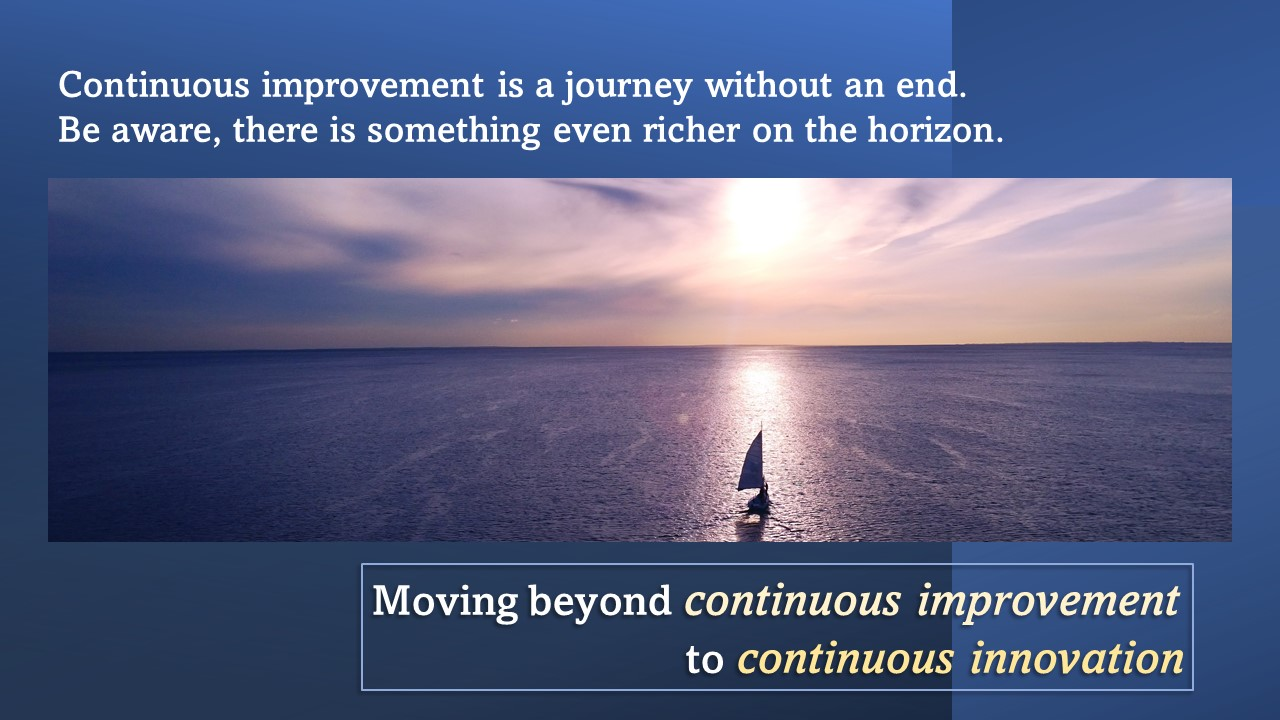
Deploying Continuous Improvement is no picnic. It requires commitment, patience, hard work, and a critical shift in the organization’s culture before CI can be sustainable and effective over the long haul. A transition this massive can’t be well-established through a couple of seminars and an inspirational book or two. As I’ve spoken with Continuous Improvement gladiators over the years, I’ve recognized more and more that sustainable improvement is the immediate goal we often fixate on, but it’s important to realize that an even better land that lies beyond. Continuous Improvement is only a milestone on the journey to Continuous Innovation.
Inertia in this life is such that change is naturally resisted. And we can agree that change for change’s sake is a waste of our time met with justifiable resistance. There must be a purpose for the change for the change to qualify as an improvement. Improvements make a difference somewhere that matters. Unfortunately, improvements have limits. You see, improvements are by their nature instruments to take us closer to a known standard. Improvements reduce the effort required for, speed up the response of, or maybe simplify some legacy process. Improvements may increase the utility, affordability, or quality of a product. Nevertheless, an ideal standard is available to validate that this is indeed an improvement to how we normally operate.
Ideally, if properly trained, empowered, and motivated our entire workforce can tackle improvements all day long – and usually without assistance. Yet reaching that steady state of improvement seems unattainable to most of us practitioners. To dream beyond to the realm of innovation seems unthinkable given our current reality.
This is a good place to unpack the notion of innovation. Innovation is the fruit of pioneering beyond the known and exploring what was thought impossible just a short time ago. Innovation is setting the best approach aside to rethink the problem from an entirely new angle. Innovation isn’t meeting a benchmark; it’s leaping beyond it. The catch, however, it that innovation involves risk and mere improvement does not.
Improvement is always safe in the sense that we use standards, benchmarks, best practices, and other “known artifacts” as our guides. The fact that these are known artifacts means that they have already been discovered, observed, applied, and refined by someone else. They are safe because we know empirically that they are already producing the desired results for someone somewhere and just need to be adapted to our particular situation. Innovation has no such assurances and no guarantees, yet the potential rewards are immense. The sign clearly reads: “Innovate at your own risk.”
If you are recycling or adapting an idea used elsewhere, you are improving. If, however, you are chasing a new idea – through discovery, experimentation, and synthesis – you’ve wandered into the land of innovation where you have excusive rights to unique new capabilities and insights. In the land of innovation you have valuable intellectual property that can be leveraged as a distinct competitive advantage. This intellectual property “know-how” usually takes the form of patents or trade secrets, and it is equally important to any portfolio as are your marketable products and services.
Ideas must be harvested, curated, evaluated and ultimately pursued to convert them into something of value for the organization. As you build and establish your improvement system, are you maintaining a focus on the next horizon, innovation? How robust is your idea pipeline? Can your organization sustain the improvement initiative sufficiently so that it can dabble purposefully in innovation? How has your intellectual property been bolstered by your improvement system?
I maintain that your improvement system, with its vast part-time army of change agents, has the potential of playing a more dominant role in innovation than the engineering team – if we can only lay the proper groundwork. I challenge you to think about how you might lead your organization beyond mere improvement into innovation. Consider how you might leverage Leader Standard Work to resource your innovation program space. No need to settle for just improvement going forward.
Lean in and Lean on.