
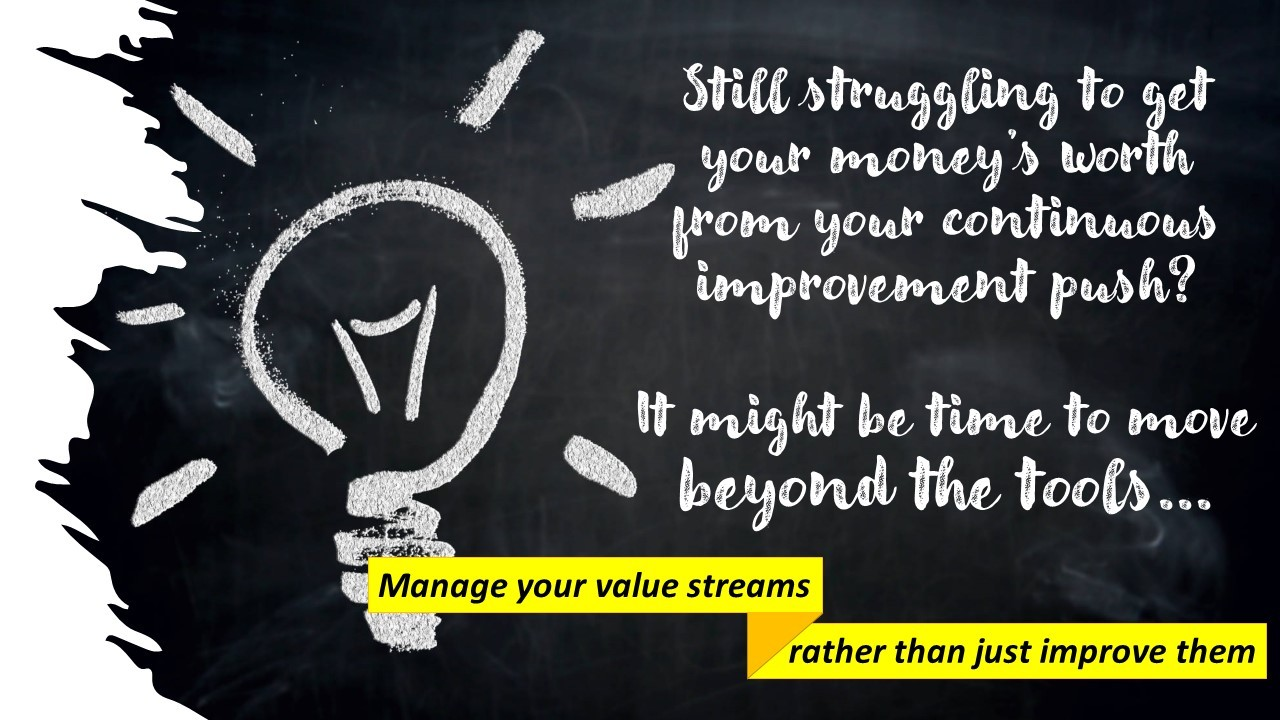
All too often organizations want to claim to be Lean without committing to the journey to become Lean. Lean isn’t for the faint of heart, you see. It’s fairly easy to adopt all sorts of Lean tools while neglecting the philosophy and the critical cultural shift that follows. Lean should be a transformation, rather than a program. Posing as Lean is trendy these days.
There are several tell-tale markers of Lean counterfeits. The one I want to discuss today is the notion of having value-streams without value-stream management. Most any continuous improvement program begins and concentrates on the individual functions that contribute value to the customer. That’s an excellent place to start. Unfortunately, they rarely seem to graduate from there to a broader perspective of the entire end-to-end value chain. These organizations can easily fall into the trap of thinking that excellent processes create excellent value chains; but this is not so. The individual functions must not only be rationalized and tamed, but they must also work in continuous concert with all the other linked functions to provide maximum customer value. Allow me to explain.
Consider for a moment that you are a shopper at a large grocery store. As you complete the periodic task of grocery shopping you stop by the butcher, the deli counter, the bakery, the florist, and a host of other sections before moving through the checkout line. Each of these independent departments is adding value to your overall experience. If looked at individually, each of these stops may be confident that they have superior efficiency – having driven waste out to the greatest extent possible. However, as a frequent shopper you may recognize outages, delays, ambiguities, and other frustrations that cause you to dread one department over others; which might even drive you to avoid certain stops along the way or make dynamic changes to your shopping list. Opportunities have been missed and the customer experience is diminished.
Our organizations are no different. We cannot labor under the misconception that surgically removing waste in one isolated function will result in meaningful improvement to the overall customer experience. Nor can we assume that excellence in one function’s internal metrics make that function an excellent member of the overall value chain.

Please realize that supporting functions have the hardest time making this intellectual connection. They rarely, if ever, have any direct feedback from the ultimate customer or even the next internal customer in the end-to-end value stream. How are they supposed to know if they are delighting or disappointing the customer if no feedback is received? If they are measured or graded by a unique standard, how would they know if they facilitate value or hold value up? Lean organizations are compelled to look at the big picture and keep the customer experience at the forefront to stay relevant.
What is the solution, you might ask? I would submit to you that active, consistent value-stream management is the answer. Value stream management (by product or service) ensures that flow is scrutinized and valuable feedback is readily available. Value stream management provides an ongoing audit of the entire value chain while it provides crucial accountability to the member functions regarding performance, quality, and delays. Functions can more easily adjust and align when provided with real-time, customer-oriented feedback.
Ideally, value streams have readily identifiable value stream managers that can walk the process from function to function, end to end in order to identify with the ultimate customer and help refine the overall process flow as needed. If you have identified your value streams but do not have value stream managers, you’re likely blind to the dips, bumps, stalls, and traps in your organization’s processes. Also, note that waste will accumulate between the processes if there’s no one vigilantly policing it.
For continuous improvement to pay real dividends, you need to ensure that all functional departments are capable, efficient, and balanced for demand. Only solid value stream management offers the ability to constantly assess these interlocking processes for the benefit of your customer. When you are ready to move beyond mere tools and take your Lean journey to the next level, please consider incorporating value stream management into your strategy. Transformation is within your grasp.
Lean in and Lean on.