
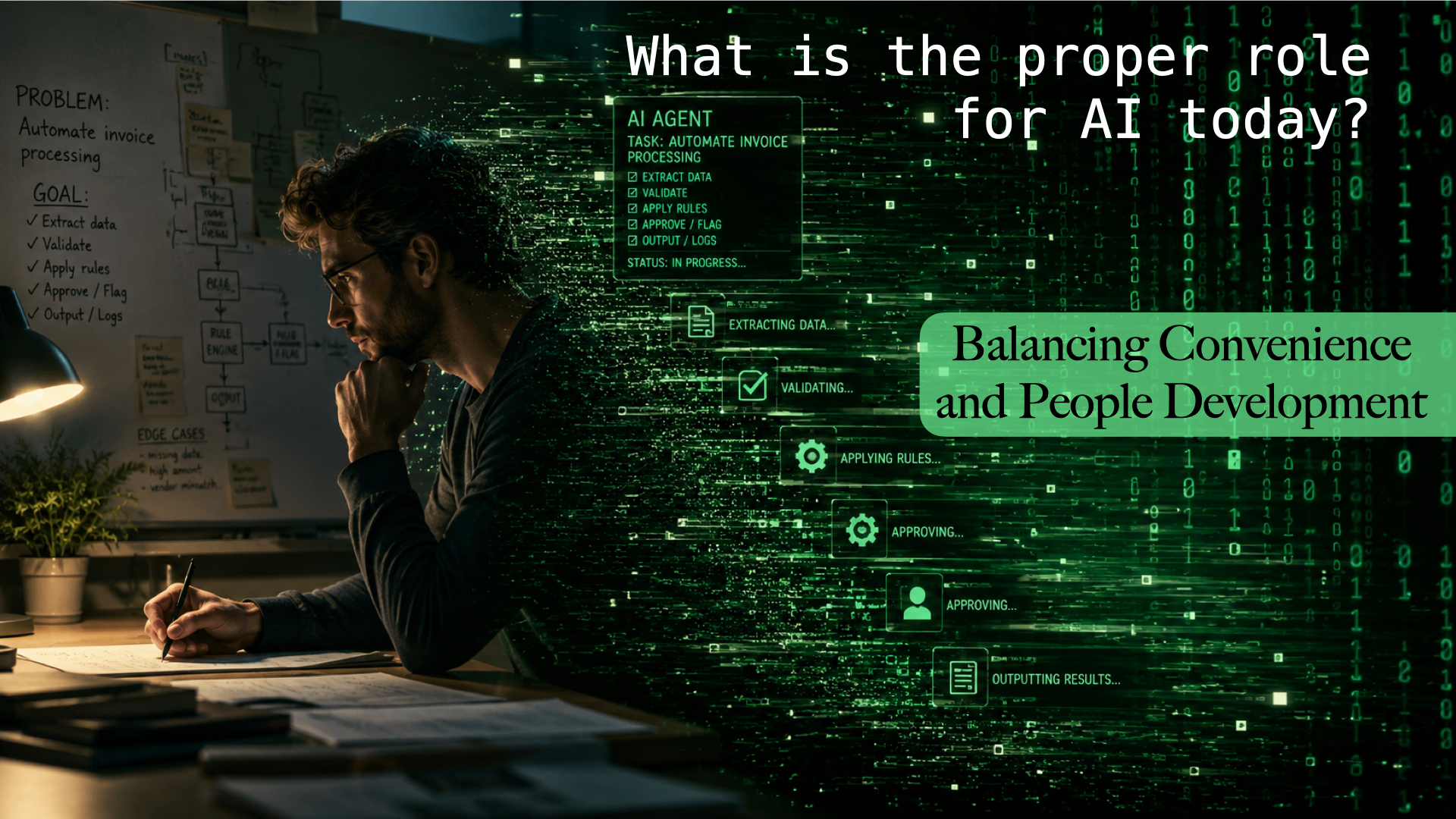
I realize that I am wading into controversial waters with this topic, but AI is truly the proverbial elephant in the room at this point in time. I am by no means a technophobe. Nor am I the type that cowers in the dark corner fearful that the human apocalypse is drawing near. I believe that I am a level-headed pragmatist that has carefully weighed the pros and cons of the current situation and is particularly concerned with the many unintended consequences disruptive technologies inevitably bring with them.
Let’s discuss the amazing benefits that Artificial Intelligence offers society, and in particular, industry. AI has one striking capability that is impossible to ignore; it can detect obscure patterns in copious amounts of information. This is the reason AI was invented and no other technology even comes close. Humans also have a remarkable ability to naturally detect subtle patterns but our abilities are generally best suited to our visual senses, and also best applied in the detection of anomalies, rather than overall patterns in general. AI has no such limitations. It can be tailored to detect patterns (both good and unusual ones) in any form imaginable; musical, digital, shapes, numerical, or even abstractions. Crunching enormous data sources is no problem for today’s sophisticated AI models to process.
Do you want a safe, reliably successful solution to a problem? AI can process millions of relevant records to assess what solutions to similar problems had in common, removing both risk and delay. Experimentation, which was a mainstay of the solutioning process of the past, becomes quietly obsolete. Discovery and learning related to proving things out for ourselves is replaced with the convenience of automated solutions. In many pursuits, I think this is a reasonable tradeoff for progress, but maybe not in all endeavors.
For example, America is in a health crisis right now. Generally speaking, we have never been more food secure. We have never been more economically prosperous. We have the most advanced health care systems in the world. And to cap it off, we have never had more information and access to knowledge than at any time in history. Yet, our ability to leverage that knowledge and nourishment is not reflected in the physical condition of the average American. Preventable disease is on the rise. Why is that? Convenience has stripped us of the routines, skills and discipline we need to individually realize good health. We know better, but good health generally isn’t worth the effort, and we suffer as a result.
What is the analogy here? Convenience always comes at a cost. The unintended consequences of over-reliance on AI are my chief concern. We are strong when we exercise our muscles, both physically and intellectually. As humans, we need problems to solve, just like we need weights to lift. Problem solving is a skill – and a survival skill at that. Creativity is also a skill, more natural for some than for others, but a skill, nevertheless. My concern is that AI can tempt us to neglect the very survival skills we need to thrive in life.
Also, what are some of the cons associated with AI that we don’t seem to fully appreciate? AI is only as good as the data it feeds upon. “Free-range” AI models that consume everything on the internet are being exposed for incorporating misinformation, speculation, satire, and filth into their sophisticated calculations. Be aware that bad actors are intentionally poisoning the internet for this reason. Even curated models are highly susceptible to junk data. The notion of “garbage in, garbage out” is a real threat.
AI is inherently designed to detect targeted patterns and trained on empirical data to mine those patterns. Great. However, recognize that innovation usually exists on or past the fringes of our known experience. AI gives us safe, efficient, reliable solutions, not truly innovative or game-changing ones.
What are some of the troubling echoes we see today related to AI? The disruptive nature of AI can simplify some of the entry-level positions in businesses by automating routine tasks, right? Now we’re seeing a growing chasm in the development pipeline of many professions where no one will be qualified to step into senior roles as people retire, because many entry-level positions are being eliminated. Schools are reporting chronic cheating behaviors related to having AI do their homework and write their papers, confirmed by decreasing test scores. Basic reading, writing, and arithmetic skills are being neglected by cutting corners using a tempting and convenient tool.
You may be asking yourself if there is an argument here related to Lean methodologies. My position is this; AI is a great tool to monitor your multitude of production data, compiling performance and alerting you to noteworthy abnormalities. It is also a fantastic instrument to help you curate historical improvement projects, facilitating research and helping share learnings throughout the organization – addressing a significant challenge for most organizations. I would caution anyone, however, on the application AI to identify and/or solve problems related to continuous improvement. This is a human skill honed through experience and coaching over countless iterations and should be regarded as such. Even populating traditional A3s is still often done by hand in pencil to reinforce the analog learning process for wholistic people development in many companies.
The very best Lean organizations are known for deliberately developing the skills of creativity, problem-solving, and rapid experimentation in everyone, not just a select team of professionals. If over-reliance on AI threatens the development of these skills and behaviors, you may want to rethink your approach. AI should assist people rather than replace or weaken the individuals we claim to respect.
Lean in, and Lean on.