
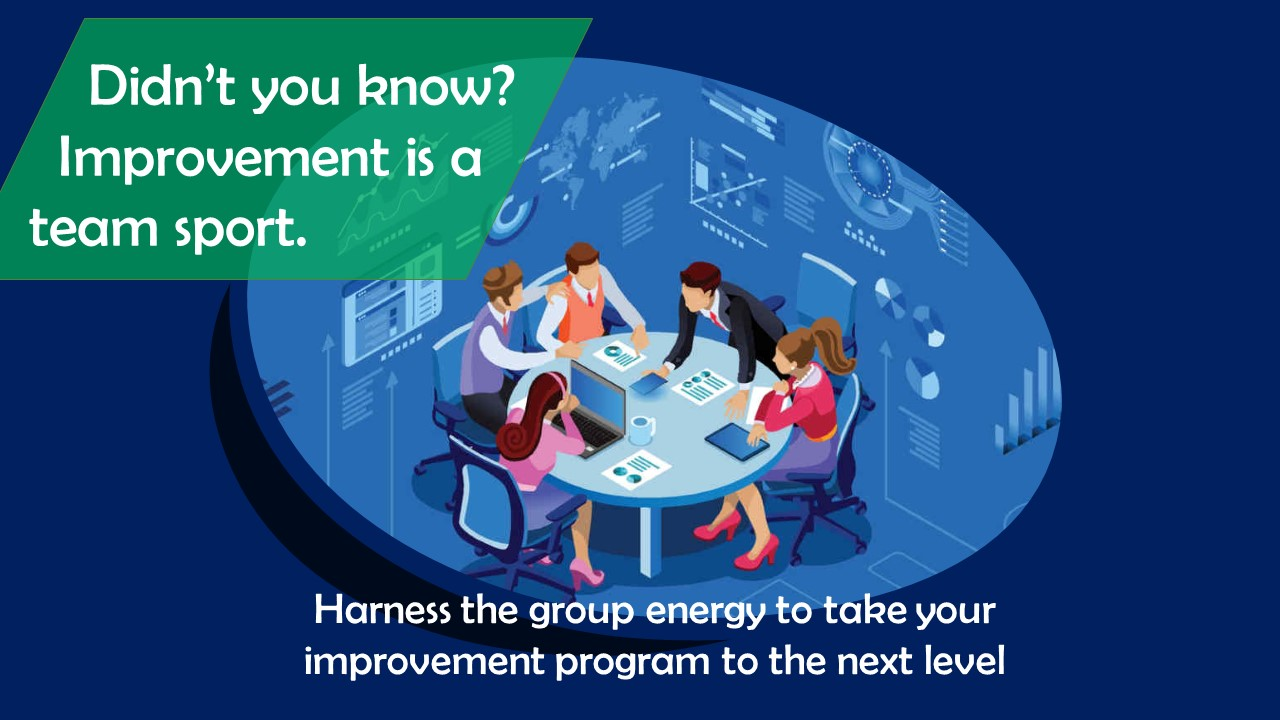
As the saying goes, “there is no I in team”. You will also find it true that improvement – sustainable, intense, and profitable improvement – isn’t well suited for just the individual either. Whether continuous improvement (kaizen) or radical step-change improvement (kaikaku), we often make the grand mistake of relying on the genius of one when real genius is leveraged in the power of many perspectives.
I get it. We live in an overly individualistic society where real relationships are somehow replaced with virtual “friends” on social media. Our self-worth is often wrapped up in the specific, named contributions we make at work and our resumes clearly enumerate and highlight them. We may even be reminded by our employers that they are counting on us for a great idea or solution, because that is our explicit function in the machine.
Working in teams means sharing credit. It means dealing with potentially unreasonable or disinterested people. It can mean slowing things down to a precarious pace or costing the company more than was budgeted. But be advised, creative work is always best done by a team of enthusiastic and aligned minds. You shouldn’t be doing it all by yourself. Have you considered the following team-oriented benefits related to improvement activity?
· Inspiration – Having a multitude of perspectives stimulates our imagination. We can fully leverage the rich experiences and viewpoints of others in the creative process only as a team. Effective Improv teams rely on the notion of “Yes, and…” wherein ideas are built on top of one another without judgement until they have been fully explored. Think what you could do with collaborative inspiration. We don’t need studies to show that group solutions are always superior to individual ones, but many exist if you still need persuasion.
· Protection – The flip side of the inspiration coin is protection. Multiple viewpoints and curious sets of eyes help us identify flaws and vulnerabilities that we might be otherwise blind to. Simply put, it is wise to have others around to help detect problems early; before they become costly. You can take it a step further using proven techniques like the “6 Hats” approach to allow the group to roleplay as ideas are developed and processed.
· Succession – Succession planning is a persistent blind-spot for most organizations. Ensuring proper coverage for all our functions well into the future is a task not left to chance. For this reason we need to be actively developing skills and experiences in people that prepare them for the needs of the future. Investing in others has to be deliberate or it won’t happen. Also, leaders need to have freedom to move up, move on, retire, or even take a break without unduly disrupting the organization. It’s risky and unhealthy for the company to be overly dependent on just you. Think about that.
· Liberation – Feeling the need to generate the right solution every time on your own is an unreasonable burden. If you succumb to that like I have, cast it off, my friend. Whether you are a leader, a manager, or an individual contributor, don’t accept the pressure to always be the smartest person in the room. It can drain the life out of you. The synergies of working in teams can often demonstrate that the output is more than the sum of the individual parts. Consciously let your ego go a little to make room for the creative juices of others.
· Maturation – If you believe in Lean philosophy, you know that in order grow and mature, the organization should be evolving to a state of enthusiastic collaboration around common goals. This is an extended team culture by design. Teamwork isn’t just for creative improvement; it’s the lifeblood of a truly Lean culture. I’ll recommend John Dyer’s book, “The Façade of Excellence” as a good read on the topic. Part of our Lean journey has got to include deliberate migration towards team-based operations to be successful. You can set the example and get that ball rolling.
This principle isn’t new. There’s a poignant proverb that goes “Plans fail for lack of counsel, but with many advisers they succeed.” This advice is as useful today as it was for kings of old. We owe it to our companies and ourselves not to fall into the trap of neglecting a teams-based approach to continuous improvement. The impact of your spark would be far greater in the presence of numerous other sparks. Together we can set the world ablaze.
Lean in and Lean on.