
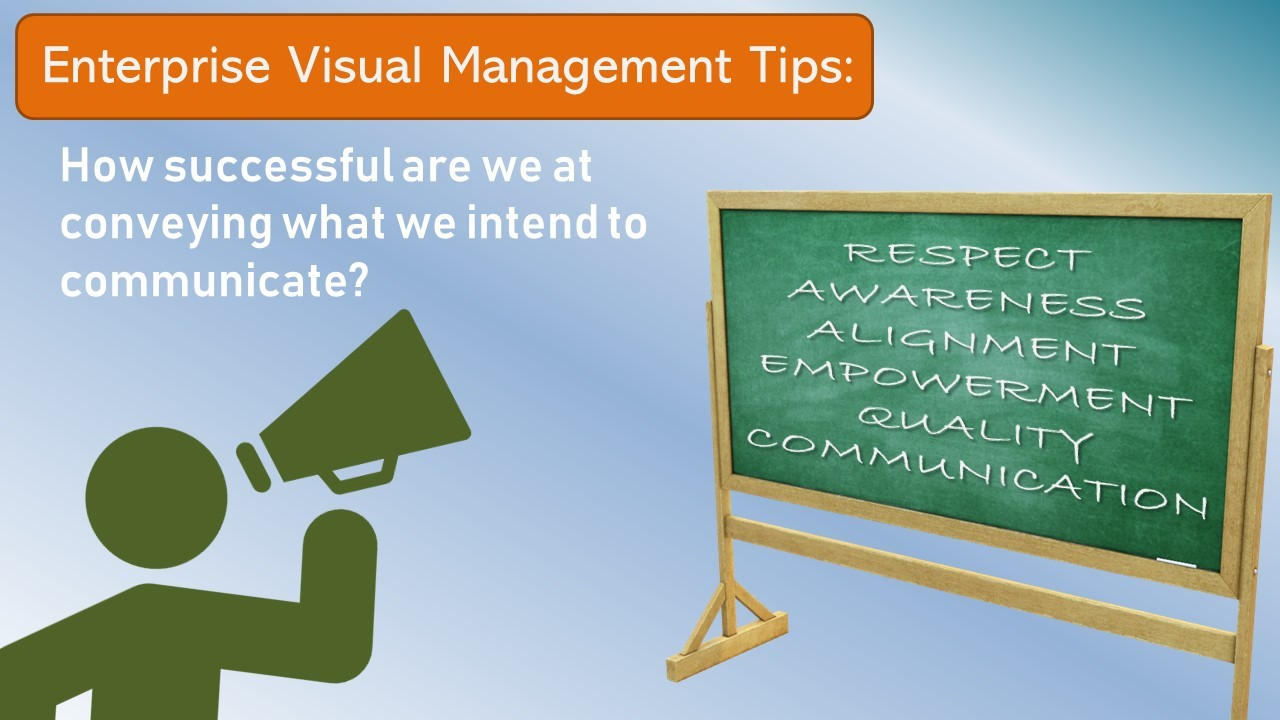
There is perhaps no greater innovation in the continuous improvement world than visual management. Visual management is always found at the core of spectacular employee engagement and is a proven means of empowering our workforce to accomplish the impossible. Allow me to explain.
During Toyota’s darkest hours there was a brilliant epiphany; engage the entire workforce, knowing that it requires that everyone have full situational awareness in real time – and by everyone, they meant everyone.
So the objective is crystal clear – to ensure that everyone has all the material they might need (especially information) to do their job fully, confidently, timely, and without error. Additionally, drive whatever is abnormal or suspicious to the surface, highlighting it to everyone around. Then empower everyone to resolve these obstacles individually or collectively in a way that prevents reoccurrence.
Proper visual management goes far beyond the shop floor. While it naturally includes work instructions, production plans, quality performance, Kanban, output metrics and the like, it also must extend to policy deployment, skills management, strategic vision, product development, and beyond. There must be complete immersion in visual management to take full advantage of the notion. Anything less will have disappointing results because of what it communicates to your workforce.
At its heart, visual management is a comprehensive communication media unto itself. It’s how the organism connects, similar to the synapses in our brains. In his book The Visual Factory, Michel Greif models the relationship as a triangle that includes “Knowing as a Group”, “Seeing as a Group”, and “Acting as a Group.” This group behavior dynamic can be intensely powerful and transformative.
What differentiates excellent visual management from just average? Here’s some basic tips:
1. It’s broadcast to everyone. It has to be fully egalitarian to be effective – everyone has the right to know; for knowledge is power. This reinforces our respect for people and counteracts the usual “us vs them” mentality. It also makes the organization transparent in a way that invites involvement at all levels. For this reason, resist visual management initiatives that are software-based or computer dashboards; someone is getting left out.
2. Visual management should be sublimely simple and easy to understand, yet still covering your bases. I tell people that we want the workspace to be intuitive and instantly legible. Get me up to speed in an instant. But no more than 3 KPIs or performance metrics for an area, please.
3. Visual management works best when it relies on relevant and locally accepted symbols and colors. Avoid overwhelming us with detail and let people absorb critical information through colored icons or shapes or even sounds. Precision is not nearly as important as accuracy and timeliness, so numbers and words may not always be necessary.
4. It drives the behavior you want. Visual management can be a fantastic alignment tool at all levels. Set a clear goal and empower people to perform together. Use it in conjunction with Kanban and andon to address delays, quality issues, or shortages rapidly. Resolve typical production hiccups with visual abnormality control. However you choose to do it, if done well it should drive the behavior you want and prevent the behavior you don’t.
5. Start with the basics and grow from there. Begin with Safety. A sound 5S program will establish visual management rapidly. Then include Cost, Quality, and Delivery aspects and grow into huddle boards. Next you might consider adding Involvement to the mix. Remember to be generous with your recognitions. This SCQDIapproach can be organic if you don’t rush it.
Lean in and Lean on.