
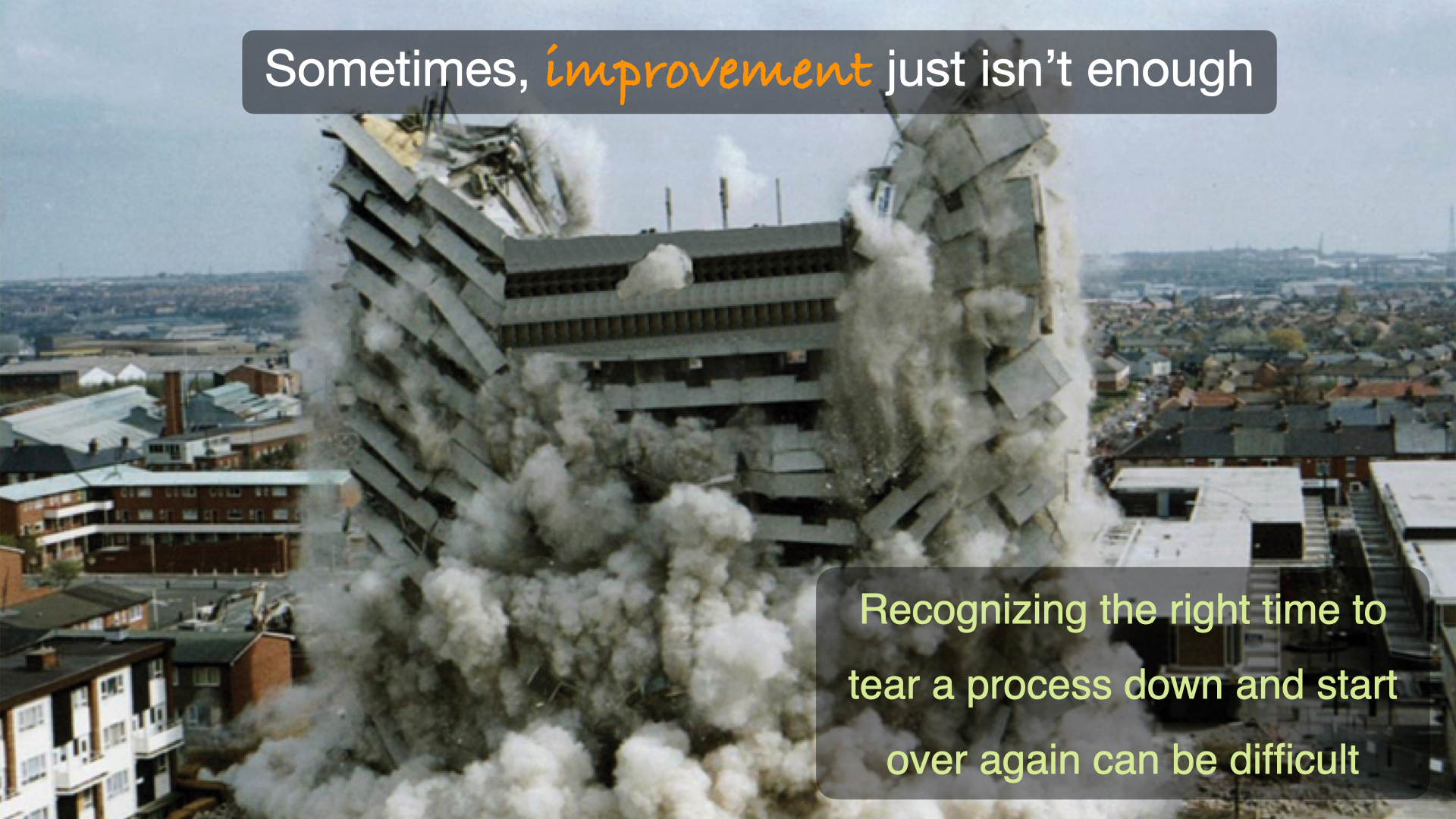
Not every problem can be solved incrementally. The uncomfortable reality associated with many leaps of progress is that revolution, not improvement is the key ingredient. If you haven’t been confronted with this truism yet, you likely will eventually. Tried and true only gets us so far in many instances.
Don’t get me wrong, I’m a diehard fan of incremental improvement. I firmly believe in the notion that any process can be refined, standardized, improved upon, and optimized. However, there is a limit to the potential of any process – especially in this new world of digitization where physical constraints become self-imposed. The disruptiveness of current technology is rightly causing us to rethink what is possible as we’ve entered a new age of change.
You see, innovation is at its heart revolutionary. Innovation stems from rejecting the normal, the known, the refined – and saying that we are going to start over again with dogged intentionality. Innovation dares to blow up the current paradigm and start over from scratch with an entirely new set of foundational assumptions. The Japanese call this type of change kaikaku, as opposed to kaizen; what we know as incremental change. Kaikaku requires extreme bravery. It is not for the timid.
If you plan to blow it all up and start over, you’ll first want to identify the true essence of value that the customer is looking for. Strip everything else away. Ask the question “What issue is the customer really trying to solve” and then build a new process tightly around that core revelation, rather than looking for helpful modifications to the existing process. Every existing solution is an amalgamation of numerous choices made in the past. Feel free to make different choices to create an entirely new solution; a radical departure from the conventional. Uncomfortable yet?
People with the heart for kaikaku are naturally uncommon, but fortunately for the rest of us, their skills are learnable through personal experience. Like explorers of old, they can lead others to search and explore and expand our understanding of the unknown. Teams and individuals alike are energized, encouraged, and empowered by these fearless leaders and – if properly supported – are apt to develop an appetite for radical change themselves. Remember, expeditions are risky by nature and are often unsuccessful. Kaikaku leaders accept setbacks as a learning experience and grow stronger as a result.
So how do you know when incrementalism has reached its end and the system likely must be burned to the ground to be built back up again anew? There are some telltale signs that it is time to resort to kaikaku-styled change.
- You lag behind the competition and need a true breakthrough. To make up ground and potentially differentiate yourself among a crowded field, revolutionary change may be in order. Be prepared to invest liberally in development in order to push back the boundaries of the unknown.
- You see only marginal results from incrementalism that don’t justify additional investment in some particular process. When improvement seems to plateau you must ask yourself the question: Do we need fresh perspective or perhaps a different approach to move this idea forward? Don’t cling too long to convention. Be quick to move talent around, synergize teams, or challenge the status quo as needed.
- Your vision can’t be achieved using current processes. If you believe you’re at the limits of what can be done with the processes at hand and the vision is still well out of reach it may be time to start over. Think on a grander scale and reform the process to match the vision.
- The process is overrun by complexity. The first rule of improvement must always be simplification. Starting over may be advantageous to incremental improvement if complexity has gotten away from you.
- The process crosses boundaries of uncooperative functions. If essential collaboration is proving to be an impossibility, kaikaku may be a good solution Many processes cross functional boundaries both internal and external. If bringing these parties together is out of your control, you might have to resort to out-of-the-box kaikaku thinking for an all-hands-on-deck problem.
Lean in, and Lean on.