
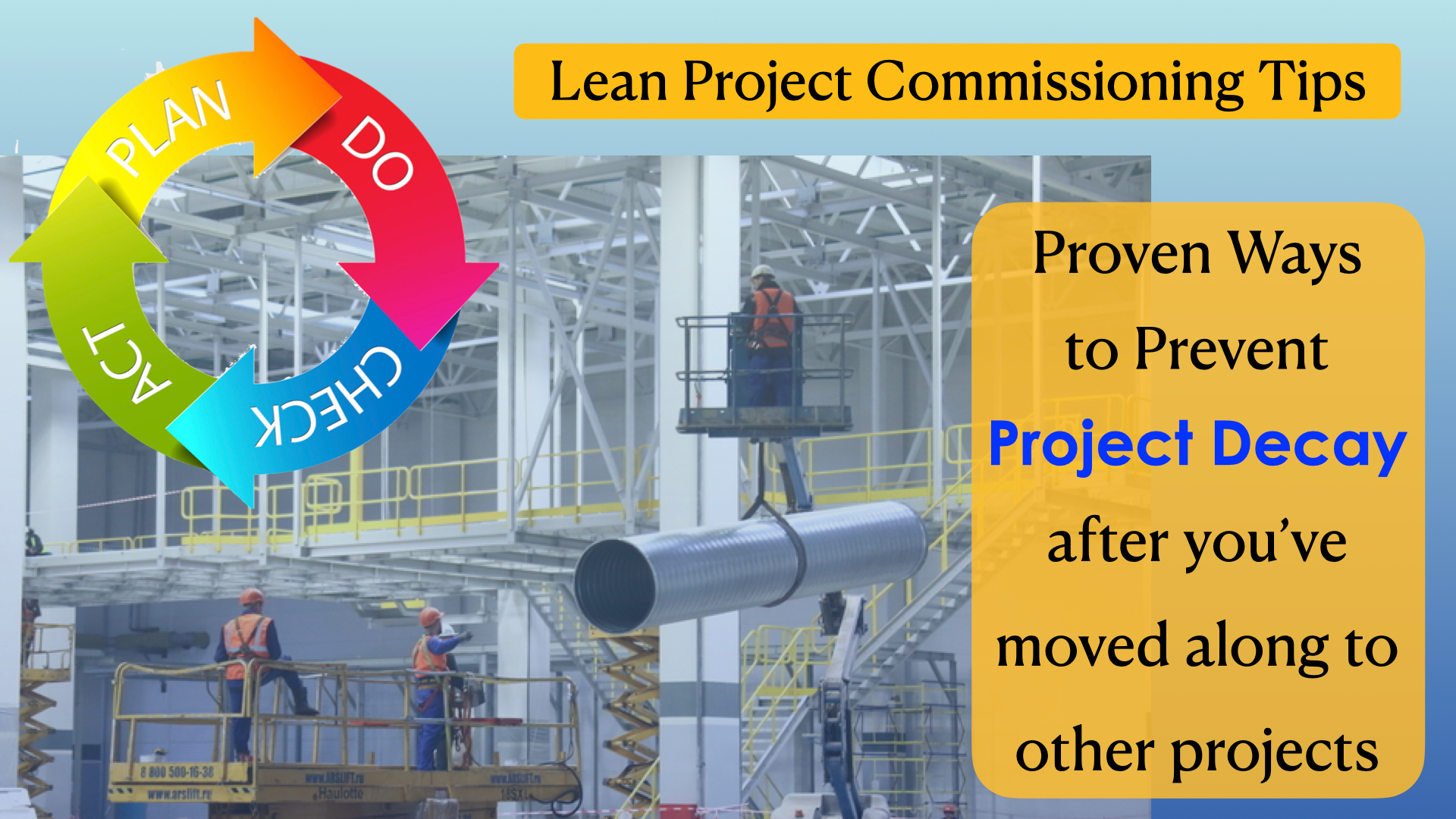
Allow me to don my PMP hat for an extended moment. In the continuous improvement world, projects come in all types and sizes. They may be small kaizen-based projects, intensive Six Sigma improvement initiatives, ambitious new product launches, or even enormous green-field site construction projects. Regardless of the size, all projects share commonalities that need to be addressed, namely; design, execution, and commissioning. Let’s focus on commissioning.
Commissioning is often thought of as the instant where the project is completed and turned over to operations. However, commissioning is an important validation and preparation step that should not be short-changed. In CI circles we know this as the “Control” step of DMAIC or the “Act” phase of the Plan-Do-Check-Act cycle. The project isn’t finished until all the loose ends are cleaned up completely and the project customer has everything they need for reasonable success.
There’s pressure and huge temptation to stamp a project “DONE” and move on to the next big thing. Before we celebrate the latest and greatest solutions, however, we must be diligent to complete the commissioning activities or else we risk having to come back later and restore or, even worse, redesign the entire system. These are the steps that need to be completed prior to us patting ourselves on the back and basking in the glory of accomplishment.
- DOCUMENTATION – Is all the essential documentation in place prior to launch? At a minimum, this includes standardized work instructions for operations and maintenance. It should also include the new sequence of operations embodied in the future state plans. This means that expected take time, lead-times, acceptable inventory levels, and personnel requirements are clearly identified. When expectations are clear, normal verses abnormal conditions are easy to see and correct. Additionally, required maintenance intervals and pre-determined critical spare parts are needed to wrap this step of commissioning up.
- VISUAL MANAGEMENT – No lean project can be complete without a generous application visual management elements. How the operational team will assess health and supply aid is largely dependent on how effectively the process is represented visually. Andon lights, signals, production boards, audible tones, email notifications, etc. can be used to translate the status of the system or its components to the right parties to prompt immediate examination or action.
- FMEA – Failure modes and effects analysis is assumed to be an essential step in the overall project. A followup FMEA that validates the countermeasures applied to the system and looks afresh for new vulnerabilities is a must. FMEAs are iterative and need to be applied periodically rather than once at the onset.
- EQUIPMENT & SYSTEM CHECKS – For smaller projects that replace or upgrade one piece of equipment, simple equipment validation checks are sufficient before putting it into service. However, when multiple suppliers’ equipment is being integrated into a system, this is not enough. Integration is a tricky business. Each subsystem or component must function in unison with all the others. Validation that each and every element operates within specifications (takt time, OEE, changeover time, maintenance intervals, etc.) is critical and cannot be neglected.
- STRESS TESTING – Systems, be they software, mechanical, service, or a combination need to be tested to determine their existing limits. Use, misuse, and abuse scenarios all must be explored to identify the weaknesses and opportunities that exist in the system. Without stress testing the new system prior to release, we find ourselves reactively chasing after complaints. These test experiences feed and inform iterative FMEA activities so we can identify and resolve many problems before operations experiences them.
- OPTIMIZATION – While not required, optimization around a key performance indicator is easiest at this stage of development. Speed, mean-time between failure, quality-related characteristics, and operational cost are common optimization points to consider before the transfer of ownership is complete. You can refer to my previous article on continuous Improvement Phases for more suggestions on this rich topic.
- COMPREHENSIVE TRAINING – Shockingly, this step is commonly minimized or neglected. A new or revised process is introduced, a new piece of equipment installed, or a new product hits the line and often training is only superficial. Operators, supervisors, trainers, maintenance personnel, and other key process stakeholders need to be fully appraised of every aspect of the newest solution to ensure it performs at its best from the start. We can’t afford to short-cut this step.
The long-term success and effectiveness of projects depends in large part on how well we close the loop on the commissioning activities. If we are diligent in the commissioning phase of the project we can prevent the typical lurching and on-the-job-training mishaps that characterize many project turnovers, supplying a robust, proven solution that will deliver performance that might both surprise and delight management.
Lean in and Lean on.