
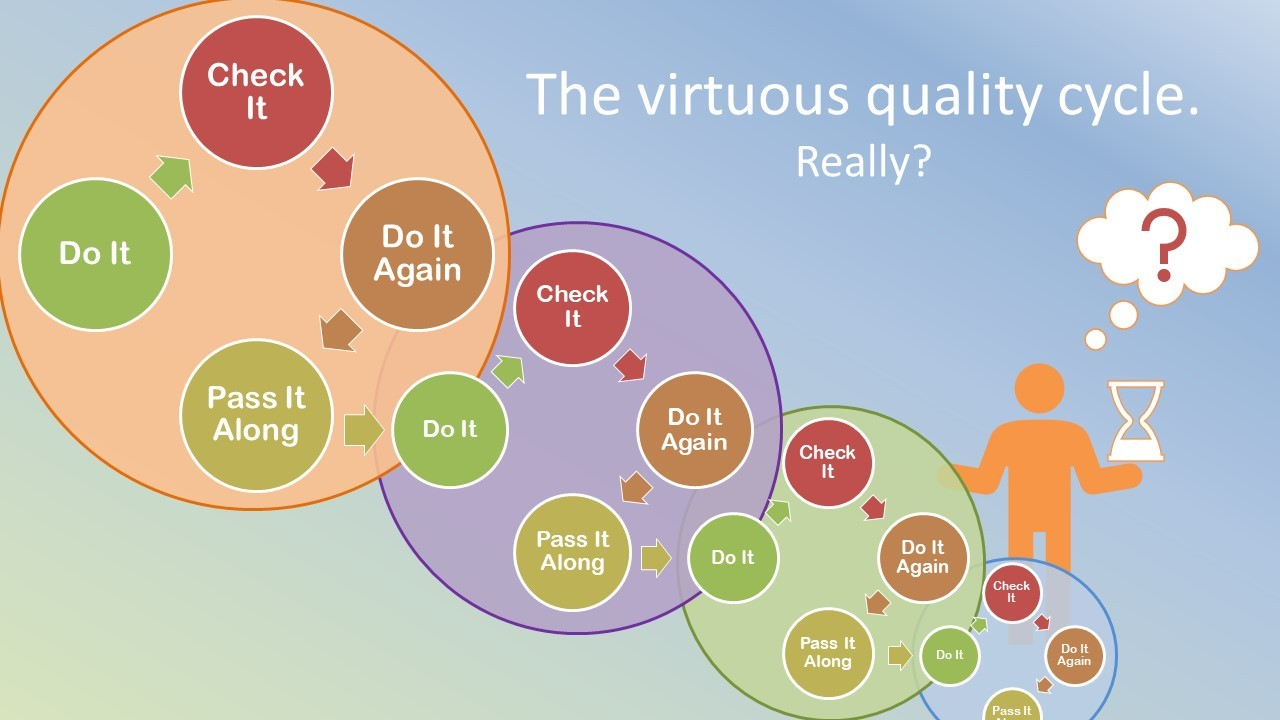
No matter our functions or our procedures in our work, we can reduce our daily burden while simultaneously increasing our productivity if would only avoid the dangers of rework. It sounds like magic, but the secret is in learning to work smarter rather than harder. Rework is that one nuisance characteristic that all processes seem doomed to share. Rework of some level naturally occurs in everything we do. What we often fail to recognize is that by doing things right the first time, we always minimize the total energy we have to apply to a task.
Chances are you deal with rework every day and don’t even recognize it anymore. We become desensitized. Of all the various forms of waste rework is probably the most common and since we’re immersed in it so deeply, we’ve come to surrender to it on a subconscious level. The time has come to awake from our daze and free ourselves from this malady. You might be surprised to realize how much of your day is spend dealing with it.
Rework is the unfortunate act of applying additional effort to doing some task that is more than necessary to satisfy some customer need. Sure, starting over from scratch on a process is a clear manifestation of rework, but so is revisiting data, answering a question, correcting an error, clearing up something vague, or sending out incomplete work. Some level of rework is required to make the output acceptable when we fail to do it right the first time. Sufficient value has not been added until the output is complete enough to meet all the customer’s needs; no holes, no errors, no omissions, no missed requirements. Taiichi Ohno made this point in his book Toyota Production System by saying “defective goes beyond defective parts to include defective work… [where] insufficient standardization and rationalization creates waste… in work procedures and work hours that eventually lead to the production of defective products.” Rework is the natural output of defective processes.
Furthermore, rework never comes along when it’s convenient to address it. Therefore, by its very nature rework disrupts our normal flow of processing and makes us stumble to regain our cadence. This causes even more mistakes and a reduction in productivity.
Quality, both good and bad, has cost associated with it. Reactive quality – of which rework is a large component – will always cost us the most in the end. Add up all the frantic extra processing cycles, the materials consumed, the goodwill squandered, and the time wasted, and you’ll find that there is no return on investment for reactive quality. The alternative is a proactive quality approach that recognizes the potential problems early on and addresses them before they have a chance to trip anyone up.
Also, it is easy to mistake rework for refinement. But having to redo a process over and over for the sake of quality is really rework; admit it already.
The origins of the various forms of rework are many. Probably the most commonly overlooked source of rework involves a poor understanding of the customer’s requirements. When these expectations are unclear we usually end up engaging in over-processing (another form of muda) in a vain attempt to cover all our bases. Over-processing however, rarely works in our favor and we eventually resort to reworking anyhow to satisfy the customer. Think about how much of what you do is associated with customer dissatisfaction. The roots of rework are often found here.
Another significant cause of rework is simple human error. Processes never perform at a perfect state when humans are involved. Therefore, I recommend that you simplify, standardize, document, train, and apply poka-yoke whenever you see an opportunity. Notice I didn’t include “automation” in my recommendation. Nothing communicates respect for the individual better than taking a complex or difficult task and transforming it to be nearly error-proof. You team will appreciate the investment on their behalf. Poka-yoke (error-proofing) can literally boost your quality program and your morale in a single bound.
Prevention is the only effective strategy we can rely upon to avoid rework. Be mindful of the many manifestations of rework and understand what causes it so that you can successfully prevent the occurrences. Be deeply aware of what your downstream customers really need. Invest time probing into their expectations and challenges. Remember that value is always in the eye of the customer. While the ancient Greek philosophers admonished us to “Know thyself,” I challenge you to “Know thy customer” first. Never begin work until this issue is resolved. You do so at your own risk.
In addition to fully appreciating your customer’s expectations, it is important to give adequate attention to the processes and the people required to satisfy these needs. Involve your workforce in process simplification. Empower them to be part of the solution instead of just a cog. Document steps and stages of development as a team. Monitor and track output quality. Identify and embrace best practices as they are discovered. You’ll find that little by little, rework avoidance will take your output quality to the next level and unlock latent productivity you didn’t even know you had. Enjoy the success.
Lean in and Lean on.